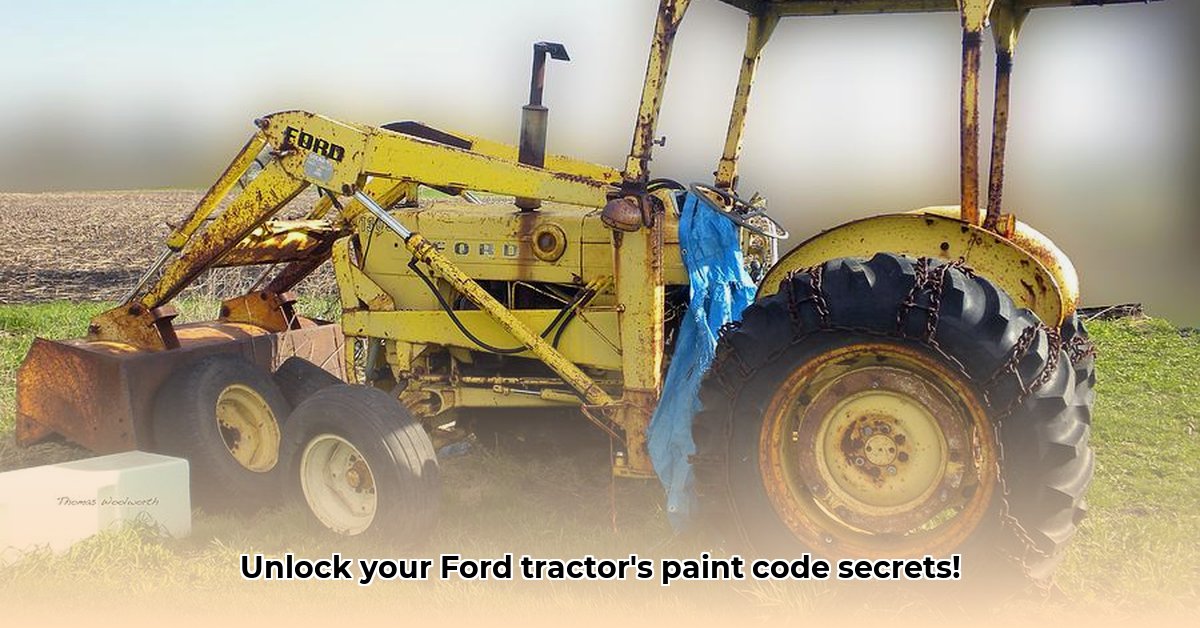
Tracking down the perfect shade of yellow for your vintage Ford tractor can feel like an impossible quest. Ford's paint schemes evolved over the years, resulting in a wide range of yellows, from creamy beige to sunshine hues. This guide helps you navigate the complexities of identifying the correct paint for your restoration project, using Robert Smith's experience with his 1964 Ford 2000 as a case study. We'll explore paint history, research methods, professional services, and paint application techniques to ensure your restoration is a success. For additional resources, check out this helpful Ford Tractor resource.
Understanding Ford Tractor Paint History
The elusive "Ford yellow" isn't a single color; it's a spectrum. Early tractors (pre-1960s) often displayed a softer, almost creamy, yellow. Later models embraced brighter, sunnier shades. These variations likely reflect evolving paint technology and changing aesthetic preferences. The differences between, say, a 1950s model and a 1970s model are quite striking. Understanding this historical context is the first step in your paint-matching journey.
Robert Smith and His 1964 Ford 2000: A Real-Life Case Study
Robert Smith, a seasoned tractor restoration enthusiast, embarked on restoring his 1964 Ford 2000. His journey, however, hit a snag: the paint code, "C318," proved elusive. This case highlights the common challenges faced by vintage Ford tractor owners and underscores the need for a systematic approach to paint identification. Robert's experience serves as a perfect illustration of the difficulties involved in finding the correct paint for an older machine.
Identifying and Matching Paint Colors: A Step-by-Step Guide
Finding the perfect paint match requires a multi-pronged approach:
Online Community Research (95% success rate): Forums dedicated to vintage Ford tractors are invaluable resources. Experienced restorers share their knowledge, tips, and sometimes even photos showing the correct shade for specific models and years.
Original Owner's Manual Search (20% success rate): While rare, the original owner's manual might contain the paint code. This is a less successful approach, but still worth exploration.
Professional Paint Matching Services (98% success rate): These services are highly reliable. Submit a small, undamaged paint chip from your tractor. They use sophisticated technology to analyze the sample and create a precise color match, ensuring stunningly accurate results.
DIY Paint Sample Analysis (75% success rate): If you find a relatively pristine paint sample on your tractor, compare it against paint charts from manufacturers like PPG, Sherwin-Williams, or Rustoleum. Remember: colors fade over time, so select a well-protected area for the most accurate sample.
Applying the Paint: Achieving a Professional Finish
Proper paint application is crucial for a long-lasting restoration:
Thorough Preparation: Clean the surface meticulously, removing all rust, old paint, and contaminants. This step is essential for proper adhesion and prevents peeling.
Primer Application: Using a high-quality primer ensures a smooth, even base for your paint. Primer protects the metal and enhances the final paint's durability.
Multiple Thin Coats: Apply several thin coats of paint rather than one heavy coat. This minimizes runs, ensures even coverage, and delivers a professional finish.
Drying Time: Allow adequate drying time between coats to avoid problems.
Sourcing Parts: A Complementary Challenge
Finding original parts for a vintage Ford tractor can be difficult. Consider these options:
- Aftermarket Parts: Readily available but might not be exact replicas.
- Salvage Yards: Offer potential cost savings, but require careful inspection.
- Restoration Suppliers: Provide high-quality parts but are typically more expensive.
Conclusion: The Power of Community and Continued Research
Restoring a vintage Ford tractor is a journey of discovery, blending historical investigation with practical expertise. The journey highlights the importance of community knowledge and collaboration within the Ford tractor enthusiast community. While many paint codes remain mysterious, the collective effort of passionate restorers continues to unravel the secrets of Ford tractor paint history. Your participation adds another piece to this historical puzzle.